The Rise of Muslim Censorship Online
Algorithm Bias Silencing Muslim Voices
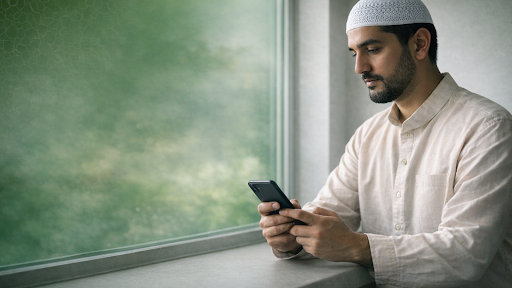
In the digital public square, a systemic pattern is emerging: Muslim content is disproportionately flagged, removed, or quietly buried by automated moderation systems. This structural censorship is forcing a community to self-censor and redefining acceptable online discourse.
You know what it's like — You post something that matters to you.
A reflection on faith. A comment about Palestine. A reminder about prayer. A critique of injustice.
Minutes later, it is removed. Or flagged. Or quietly buried.
No explanation. No clarity. Just silence.
At some point, many Muslims stopped asking why this happens. It simply became part of the experience of being online.
How did this become normal?
The Pattern We Can't Ignore
Conversations around Muslim censorship online are often dismissed as anecdotal. But the evidence tells a more serious story.
Human rights organisations have documented widespread removals of Muslim-related content in recent years, including a Human Rights Watch report documenting over 1,000 instances of content removal affecting Palestinian voices. Surveys indicate that a significant majority of Muslims report experiencing Islamophobia online.
These are not isolated glitches. They point to patterns.
Content moderation systems rely heavily on automated tools. Algorithms are trained on datasets that often reflect existing societal biases. When religious language, Arabic terminology, or political discussion linked to Muslim-majority regions is repeatedly flagged as "high risk", suppression can become systemic rather than incidental.
Shadowbanning is particularly difficult to prove. Engagement drops. Reach collapses. Accounts stop appearing in search. There is no clear notification, no transparent appeal.
For young Muslim creators, activists and professionals, this creates an invisible ceiling.
The issue is not simply about removed posts. It is about disproportionate filtering of Muslim identity and discourse in digital spaces that claim neutrality.
When Silence Becomes Self-Censorship
Beneath all of this is a simple fear: if I speak honestly online, will there be consequences?
Consequences for my reach. My reputation. My future.
When that question becomes constant, expression stops feeling free.
Over time, something more subtle happens.
People adjust.
They soften language.
They avoid certain topics.
They choose not to post at all.
Faith expression becomes filtered before it is even written.
This is where algorithm suppression affecting Muslims becomes more than a technical problem. It becomes behavioural.
Young Muslims entering public conversations online quickly learn what performs well and what attracts scrutiny. Discussions about Palestine, criticism of foreign policy, even overt religious language can feel like calculated risks.
Professionals worry about reputational consequences. Students worry about future opportunities. Creators worry about losing accounts they have spent years building.
The result is a quiet narrowing of expression.
And when a community begins to self-censor, the broader public conversation shifts without anyone explicitly noticing.
Why This Matters Beyond Social Media
This is not just about posts and platforms.
It is about identity.
For many Muslims, faith is not a private accessory. It shapes worldview, ethics, speech and action. When digital spaces restrict or penalise visible expressions of that identity, the impact is cultural as much as technical.
It also affects community power.
Digital platforms are today's public squares. They influence narratives, mobilise support and shape global awareness. If Muslim voices are consistently suppressed or deprioritised, representation suffers.
Digital autonomy matters because community narratives matter.
If infrastructure determines whose voice travels furthest, then infrastructure is no longer neutral.
The conversation around Muslim censorship online is therefore part of a wider discussion about digital sovereignty. Who builds the platforms. Who sets the rules. Who defines what is acceptable.
These are not abstract questions anymore.
What a Faith-Aligned Platform Looks Like
If the problem is structural, the response must also be structural.
A faith-aligned platform does not mean isolation. It means intentional design.
- Privacy-first architecture, where data is not exploited.
- Transparent moderation policies, not opaque algorithm shifts.
- Community guidelines rooted in dignity rather than suspicion.
Most importantly, it means being built by Muslims, for Muslims.
When a platform understands the language, cultural context and religious references of its users, it is less likely to misclassify identity as threat.
It does not rely on algorithm manipulation to reward outrage. It does not quietly suppress conversations that are uncomfortable but legitimate.
Instead, it protects freedom of expression while maintaining responsibility and respect.
This vision sits within a broader conversation about Digital Muslim Identity — how Muslims exist, express and organise in online spaces without compromise. If you want to explore this idea further, read our pillar piece on Digital Muslim Identity.
A future where Muslims do not have to dilute their voice to remain visible.
A future where privacy is treated as a right, not a trade-off.
A future where community infrastructure is owned, shaped and governed with intention.
A Different Direction
The rise of Muslim censorship online is not about outrage. It is about awareness.
Many Muslims already sense that something is off. Engagement patterns shift unpredictably. Posts disappear without clarity. Accounts are suspended with little explanation.
The lived experience is real. The documentation exists. The pattern is visible.
The question is what comes next?
By joining the Islameet waitlist, you receive:
- Priority access at launch
- A voice in shaping features and community standards
- Early member recognition inside the platform
This is not just early access.
It is participation.